
Clinical Education
CrystLCare™
A clinical primer on our biorestorative, fluoride-free sensitivity strips — how mineral-carrying particles rebuild enamel from within to relieve sensitivity, and how to recommend them.
Sensitivity relief that rebuilds enamel
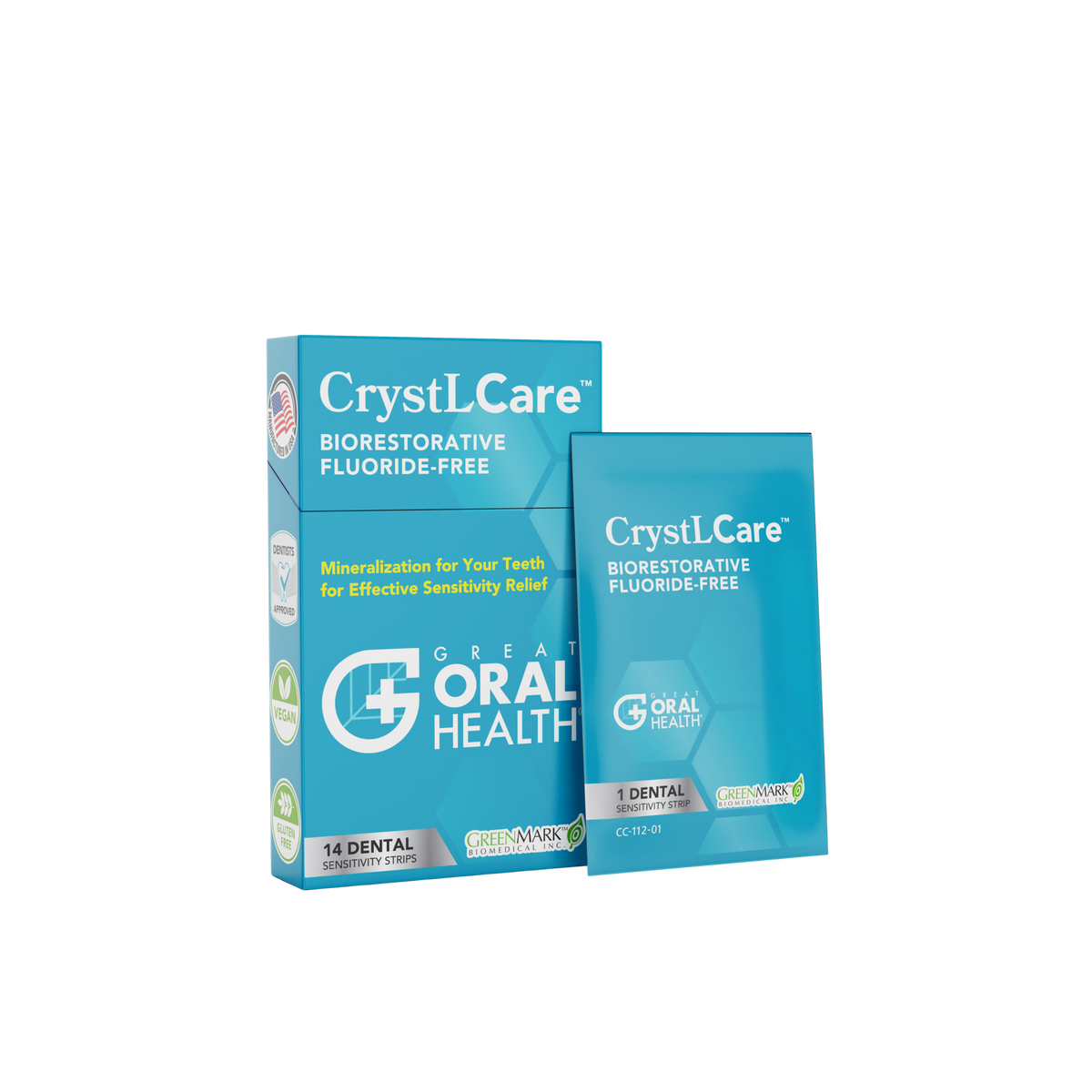
CrystLCare™ is a biorestorative, fluoride-free dental strip that delivers mineralization for effective sensitivity relief. Built on GreenMark Biomedical's patented, NIH-funded starch-particle technology, the dissolvable strip carries bioactive calcium and phosphate below the surface — deep into exposed dentin tubules and enamel porosities — where they crystallize into hydroxyapatite to relieve sensitivity at its source — a targeted, professional-grade treatment. 14 strips per box; formulated with Dr. Paul O'Malley.
Biorestorative
Carries minerals below the enamel surface for a targeted repair
Fluoride-free
Mineralization without fluoride
14 strips per box
Dissolvable dental sensitivity strips
Vegan · gluten-free
Dentist-approved, made in the USA
How it works
A patented process that carries minerals below the surface
-
Adhere & dissolve
The thin strip adheres comfortably to the tooth and dissolves, releasing millions of mineral-loaded starch particles.
-
Target subsurface
Charged particles are drawn deep into exposed dentin tubules and enamel porosities — where lesions and sensitivity begin.
-
Release minerals
Enzymes in saliva break the starch particles down, freeing bioactive calcium and phosphate ions exactly where needed.
-
Crystallize & seal
The ions crystallize into hydroxyapatite, blocking exposed tubules and regenerating demineralized enamel.
The particle technology, up close
A mineral-loaded starch particle, charged to target the tooth like a magnet
1 · The charged particle
A sub-micron (100–400 nm) starch particle carries bioactive calcium (Ca²⁺) and phosphate (PO₄³⁻), its surface functionalized with a positive charge.
2 · Magnet-like targeting
Exposed dentin tubules and enamel pores carry a negative charge. Opposite charges attract, so particles are drawn deep into the sites where sensitivity and lesions begin.
3 · Crystallizes & seals
Saliva enzymes break down the starch, releasing the minerals to crystallize into hydroxyapatite — the mineral structure of enamel and dentin — sealing tubules and regenerating the surface.
Schematic illustration of the GreenMark Biomedical mineral-loaded starch-particle mechanism. Not to scale.
Why it works
A targeted repair that reaches below the enamel surface
-
-
96%
Subsurface mineral restored
Third-party micro-CT across 50 teeth: mineral density restored to ~96% of sound in the outer lesion, 86% overall. Jones et al., JADA Foundational Science 2024.
-
~73%
Early lesion remineralized
The CrystLCare fluoride-free strip remineralized ~73% of early enamel caries lesions by micro-CT — vs ~2% for 1,000 ppm fluoride. Jones et al., 2024.
-
>90%
Dentin flow reduced
Hydraulic-conductance testing showed a large reduction in dentin tubule flow after 1–2 weeks vs deionized-water control — consistent with tubule occlusion.
-
85%
Patients improved
In an ongoing clinical pilot, 85% of hypersensitivity patients improved; mean reported pain fell from 5.95 to 1.85 after 7–10 days.
-
Micro-CT and hydraulic-conductance data from Jones et al., "Targeted Enamel Remineralization with Mineral-Loaded Starch Particles," JADA Foundational Science 3, 100041 (2024); clinical figures from an ongoing pilot at a Chicago-based DSO. Individual results vary.
Clinical pilot · Chicago-based DSO
What clinicians and patients are seeing
85%
Patients improved
Traditional hypersensitivity improved in 85% of patients within 7–10 days.
69%
Less pain
Mean patient-reported sensitivity fell from 5.95 to 1.85 after 7–10 days.
100%
Taste accepted
Rated taste completely acceptable; 95% found the strips easy to use.
100%
Lesion improved
Clinicians agreed the test demineralization lesion improved on X-ray.
Interim results from an ongoing pilot at a Chicago-based DSO; not a controlled clinical trial. For health-professional education.
Real-world dentist reports
Independent clinicians tracking lesions on radiographs, before and after
-
Dr. Kristen Graham
Patient X
- 100% reduction in lesion size on the mesial premolar (undetectable post-treatment)
- Mineral density increased from 83% to 99% of sound
- A second lesion reduced 66%, density 73% → 90%
-
Dr. Matt Gillespie
Patient Z · 2/10/26
- 69% reduction in premolar lesion size, density 80% → 89%
- 65% reduction in molar lesion size, density 78% → 90%
- Both lesions regressed a full ICDAS stage
-
Dr. James Mashni
Patient S · 3/2/26
- 100% reduction in molar lesion size (undetectable post-treatment)
- Mineral density increased from 78% to 99% of sound
- A second lesion density rose 84% → 91%
Reported by independent dental clinics; lesion measurements from AI-assisted radiographic analysis (mineral density expressed as % of sound enamel). Individual results vary and are not a guarantee of outcome.
Inspired by nature, driven by science
A patented, NIH-funded platform developed with leading research institutions
-
$4.0M in grants
Supported by NIH and State research grants.
-
Peer-reviewed
Published in JADA Foundational Science (2024).
-
Third-party micro-CT
Independently verified across 50 teeth.
-
University research
Developed with the Michigan–Pittsburgh–Wyss center.
Particle technology developed by GreenMark Biomedical Inc. with the Michigan–Pittsburgh–Wyss Regenerative Medicine Resource Center. Confirm grant figures and institutional affiliations before publishing.
Which patients it's for
Consider recommending to patients presenting with:
- Dentin hypersensitivity
- Exposed root surfaces / recession
- Post-whitening sensitivity
- Erosion & early enamel lesions
- Fluoride-averse patients
- Vegan / clean-label preferences
- Adjunct to in-office desensitizing
How to recommend it
A simple protocol — in the chair, then continued at home
-
In office
Application & education
-
Place strip(s) over the clean, dry tooth or teeth with incipient lesion(s) or sensitivity.
-
Let the patient's saliva dissolve the strip into the teeth — a light water application can help chairside.
-
Leave the treated area alone for 15–20 minutes — no eating or drinking.
-
Educate the patient on at-home application.
-
-
At home
Application & education
-
Brush and floss.
-
Place strip(s) over the clean, dry tooth or teeth being treated.
-
Allow saliva to dissolve the strip into the teeth.
-
Leave the treated area alone for 15–20 minutes — no eating or drinking.
Apply daily.
Brush and floss.
Then 1–3 months
Place strip(s) over the clean, dry tooth or teeth being treated.
-
Note: if treating a single tooth, the strips can be cut to size.
Patient talking points
Quick answers for the questions patients ask most
How does it fit alongside a daily toothpaste?
They work together. A daily hydroxyapatite toothpaste like ProMineralizer supports whole-mouth enamel every day; CrystLCare™ is a targeted, professional-grade treatment that concentrates minerals on a specific sensitive tooth or early lesion — everyday care plus a focused spot-treatment.
Does it contain fluoride?
No. It achieves mineralization without fluoride, which makes it a good option for patients who prefer or need to avoid it.
How do I use the strips?
Place one strip against the clean, dry sensitive tooth and let it dissolve — ideally at night. Use them over a full course for the best, most lasting result.
Is there evidence it actually works?
Yes. Independent micro-CT on 50 teeth (published in JADA Foundational Science, 2024) showed subsurface mineral density restored to about 96% of sound, and an ongoing clinical pilot found 85% of hypersensitivity patients improved within 7–10 days.
Is it suitable for vegans?
Yes — the strips are vegan and gluten-free, dentist-approved, and made in the USA.
Safety & formulation
What's in it — and what's deliberately left out
-
Made with care
- GreenMark Biomedical patented particle technology
- Calcium & phosphate for hydroxyapatite formation
- Vegan & gluten-free, dentist-approved
- Made in the USA · 14 dissolvable strips per box
-
Free from
- Fluoride
- Animal-derived ingredients
- Gluten
- Harsh surface abrasives
Biorestorative dental sensitivity strips developed with GreenMark Biomedical Inc. 14 strips per box. Manufactured in the USA. Full ingredient list and any device/certification wording to be confirmed against the current pack before publishing.
Ready to bring it to your patients?
Order for your practice, or book a call to get your team confident recommending it.
Statements describe the intended mechanism of action and are for health professional education; they are not a substitute for clinical judgment. Individual results vary.